
The World's Newest Overwater Villas
Saudi Arabia's Red Sea Blueprint
The luxury travel world has a new king, and it does not look like anything you have seen in the South Pacific or the Indian Ocean. For thirty years, the script for high-end water villas was written in thatch, wood, and traditional Polynesian or Maldivian styles. If you wanted the ultimate overwater escape, you accepted the brutal twenty-four-hour flight to Malé or Papeete. You tolerated the humid seaplane transfers and the fact that every resort looked vaguely like the one next to it.
Then, Saudi Arabia blew up the playbook.
Table of Contents
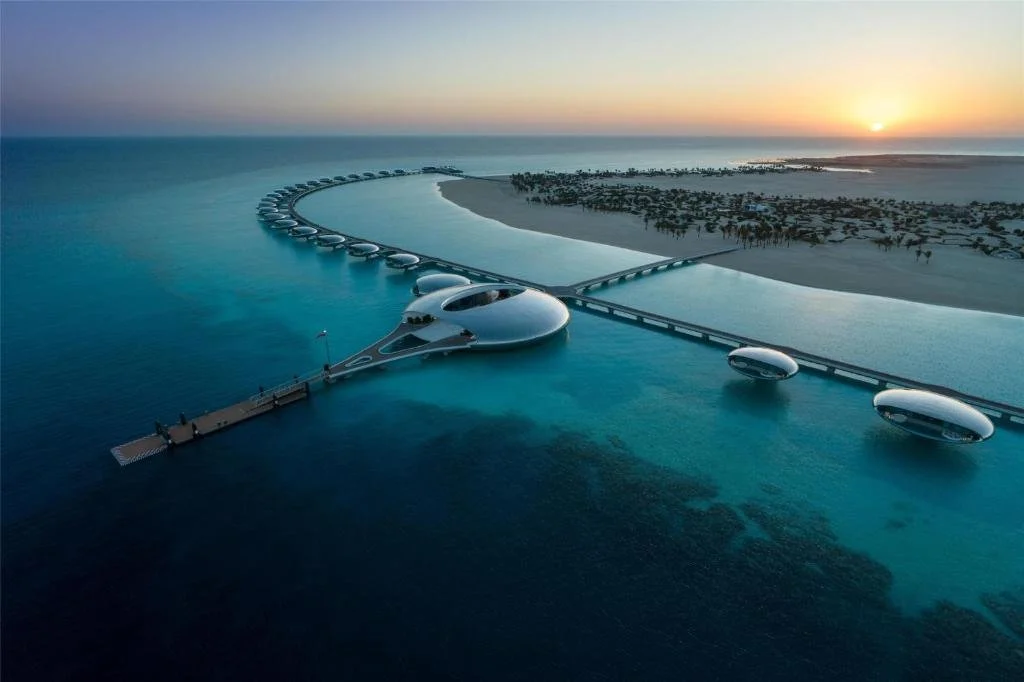
ToggleAlong the Kingdom’s untouched western coast, a massive project called The Red Sea has quietly debuted. It features some of the most architecturally mind-bending, hyper-luxurious overwater structures ever built. We are talking futuristic stainless-steel pods that look like giant liquid silver orbs floating on turquoise water. We are talking ultra-exclusive villa designs shaped like delicate sea shells.
As a Maldivian native who spent his entire life around the best water bungalows 2026 has to offer, I am usually highly skeptical of newcomers trying to copy our island magic. The Caribbean tried it and mostly built heavy wood docks. Mexico tried it and gave us beautiful mangrove canals. But what is happening in the Al Wajh Lagoon and the Ummahat Islands is totally different. They are not copying us. They are trying to out-engineer us.
If you are currently sitting in the consideration phase, clutching three different open browser tabs for a overwater trip but feeling totally overwhelmed by choices, this blueprint is for you. Let’s peel back the marketing gloss. We will look at the real logistics, the design flaws, the hidden costs, and the absolute truth about how Saudi Arabia’s new properties stack up against the reigning champions of luxury.
1. The New Global Grid: Red Sea vs. The World
When you look at the map, Saudi Arabia’s entry into the luxury overwater market completely changes the game for travelers who want pristine marine life but hate long flights. If you are flying out of Europe or the East Coast of the US, the travel math shifts dramatically. A trip to the Red Sea International Airport (RSI) cuts hours off the journey compared to trekking out to the remote corners of the Indian Ocean.
But it isn’t just about saving time on a plane. The water chemistry and physical geography of the Red Sea create an entirely different kind of luxury experience. The Red Sea is one of the saltiest and warmest bodies of water on earth. The visibility is unbelievable, often exceeding thirty meters, because there are no major rivers dumping sediment into the basin.
The coral reefs here have been isolated for thousands of years, making them highly resilient to climate shifts. When you walk out on your villa deck in the Ummahat Islands, you are looking at an untouched ecosystem that makes some of the over-touristed, bleached reefs in parts of the Maldives look sad.
2. The Big Three: Saudi Arabia’s Overwater Vanguard
Right now, three flagship properties define the luxury overwater scene in Saudi Arabia. Each targets a completely different design philosophy. They represent the absolute cutting edge of luxury overwater villas globally.
1. Shebara Resort (Sheybarah Island)
This is the property that is currently breaking the internet. Located twenty-five kilometers off the mainland coast in the Al Wajh Lagoon, Shebara features a string of thirty-eight overwater villas designed by Killa Design, the same brilliant architectural minds behind Dubai’s Museum of the Future.
The Design: Forget wood and thatch. These villas are constructed from mirror-polished stainless-steel orbs that reflect the sky, the water, and the coral below. They look like a string of massive silver pearls floating effortlessly on the surface of the sea.
The Interior Anatomy: Inside each 188-square-meter orb, you get a seamless, circular living space with curved glass windows, a private infinity pool, and a sunken outdoor lounge area.
Native Perspective: The reflective steel isn’t just an attention-grabbing design trick. It actually reflects the intense desert sun, keeping the exterior surfaces cool to the touch and drastically reducing the power needed to air-condition the interiors. It is an engineering marvel, but keep in mind that the reflective surface means you might catch glare from your neighbor’s villa if the angles match up wrong at midday.
2. Nujuma, a Ritz-Carlton Reserve (Ummahat Islands)
One of only a handful of Ritz-Carlton Reserves on the planet, Nujuma is designed for travelers who want ultra-exclusive, barefoot luxury rooted in local culture.
The Design: Designed by Foster + Partners, these overwater villas are inspired by the organic shapes of sea shells. They feature sweeping, low-profile timber roofs that blend naturally into the ocean horizon.
The Interior Anatomy: The villas are massive, starting at over 2,000 square feet. They are packed with custom local artwork, telescopes for stargazing, wall-to-wall panoramic windows, and huge private plunge pools that seem to drop straight into the deep reef water.
Native Perspective: Nujuma feels the closest to the classic Maldivian layout because the overwater villas are connected by a beautiful, elevated ring walkway that pushes them far out into the deep blue water. The snorkeling right off your private ladder here is spectacular, but because the current along the outer ring can get moving fast, you need to be a confident swimmer.
3. The St. Regis Red Sea Resort (Ummahat Islands)
Located on the same pristine archipelago as Nujuma, the St. Regis focuses on avant-garde luxury combined with their legendary hallmark butler service.
The Design: Avant-garde, fluid shapes that mimic the natural movement of the wind across the sand dunes and waves.
The Interior Anatomy: Light, airy spaces filled with natural textiles, massive outdoor decks, overwater daybeds, and private pools overlooking the vibrant coral ring.
Native Perspective: The St. Regis layout is clever because they angled the villas perfectly to capture the prevailing sea breezes. It makes sitting out on your hot deck in July actually comfortable without melting, something many architects fail to think about when they build in the Middle East.
3. The Technical Anatomy: Villa Features That Make or Break a Stay
When you are dropping thousands of dollars a night on a villa built on top of the ocean, you cannot afford to overlook the fine print of room design. Beautiful interiors look great on a smartphone screen, but bad engineering will ruin your trip fast.
Use this checklist to run your own diagnostic check before you book:
The Insider’s Villa Feature Checklist
[ ] Reflective Glazing & Thermal Insulating Glass: In the Red Sea, summer temperatures can easily climb past 40°C. If a villa does not have heavy thermal glass coating, it turns into a greenhouse. Your AC will run constantly, creating a loud background hum that completely kills the peaceful sound of the waves.
[ ] True Marine Drop-Off vs. Shallow Coral Flats: Look at the water depth underneath your villa ladder. Some water bungalows are built over shallow tidal flats where low tide leaves you standing in ankle-deep water above sharp coral rubble. You want a property that cuts right into a reef drop-off so you can dive safely into deep water at any time of day.
[ ] Acoustic Isolation from the Boardwalk: Heavy wooden docks hum when golf carts drive past. If the villa’s structural supports connect directly to the main walkway without rubber dampeners, your bed will vibrate every time room service delivers a club sandwich to your neighbors.
[ ] Sunset Orientation Wind Drift: In this region, the winds usually change direction between morning and evening. Sunset-facing villas give you that iconic golden hour view, but they also take the full brunt of the afternoon wind, which can spray salt water across your expensive cameras or outdoor dinners.
4. Arrival Logistics: Managing the Remote Journey
Let’s look closely at the actual day of travel. The primary reason people opt out of remote islands is the exhausting arrival process. Anyone who has been to the Indian Ocean knows that after your long international flight lands, you still face a confusing maze of seaplane vs speedboat logistics. You might wait three hours in a sweaty airport lounge for a seaplane that makes three stops before it finally drops you off at your resort.
Saudi Arabia has spent billions of dollars trying to solve this friction point. Their new setup is impressive, but it still has its own unique quirks:
[International Flight Lands at RSI Airport]
                    |
          +---------+---------+
          |                   |
[30-Min Seaplane Ride]   [45-Min Luxury Speedboat]
          |                   |
   (Shebara Resort)     (Ummahat Islands Resorts)
          |                   |
[Direct Villa Arrival]   [Private Jetty Greeting]
The Red Sea International Airport was built specifically to handle this layout. It runs its own dedicated seaplane airline called Fly Red Sea. If you book Shebara, you can walk off your international flight, pass through an air-conditioned terminal, and jump straight onto a seaplane outfitted with premium leather interiors.
If you choose Nujuma or the St. Regis, the resort includes luxury sedan and high-speed boat transfers in your base rate. The speedboat ride out to the Ummahat Islands takes about forty-five minutes. It is smooth and reliable, running twenty-four hours a day. That is a massive advantage over Maldivian seaplanes, which are legally grounded the second the sun sets.
5. Overwater Bungalow Privacy Audits: Spotting the Design Flaws
Let’s do a quick reality check on privacy. The sheer scale of Saudi Arabia’s resorts means they have plenty of space, but the futuristic design choices require you to run careful overwater bungalow privacy audits before picking a specific villa number.
Take the stainless-steel orbs at Shebara, for example. Because the outer shells are literally giant curved mirrors, they reflect everything around them. If your villa is positioned directly opposite another orb on the boardwalk loop, the curved surface can inadvertently create sightlines that show your deck to your neighbors.
[Boardwalk Spine]
   |         |
[Orb 1]   [Orb 2]  <-- Convex steel surfaces can bounce reflections
   \         /          revealing your private pool deck to neighbors
    \       /           if the layout angles align incorrectly.
     [Ocean]
When you are booking a shell villa at Nujuma, look closely at the distinction between the standard water villas and the sunset-facing villas. The standard villas are grouped closer together along the main pier walkway. The sunset-facing villas sit on the outer tips of the crescent, offering completely unobstructed views of the open sea where no passing dive boats or jet skis can see onto your sun deck.
6. Financial Transparency: The Hidden Costs of Red Sea Luxury
Let’s be completely open about the money. Saudi Arabia isn’t positioning the Red Sea as a budget alternative to anyone. They are swinging directly for the ultra-wealthy crowd. The base room rates at properties like Nujuma regularly cross $3,000 a night, putting them right at the top of the global luxury market.
But the real shock doesn’t come from the room rate. It comes from the incidentals on your final bill.
Unlike our established choices where you can easily compare all-inclusive vs half-board Maldives packages to lock in your total food and drink costs before you leave home, the Red Sea resorts operate primarily on a Bed & Breakfast or A La Carte model. There are no cheap buffet options here.
The Food and Beverage Premium: Because these resorts sit on isolated islands out in the ocean, every single piece of fresh wagyu beef, organic berry, or premium sparkling juice has to be boated out daily from the mainland. Expect a standard lunch for two by the pool to easily clear $200 before taxes.
The Saudi Tax Structure: This is the one that catches everyone off guard. All listed resort rates in Saudi Arabia are subject to a 15% Value Added Tax (VAT) plus an additional 5% Municipality Tax. That means you need to add an automatic 20% surcharge to your entire room bill, food expenses, and spa treatments. On a $15,000 booking, that is an extra $3,000 in government fees alone.
Excursion Premiums: Want to charter a private yacht to explore the untouched coral systems? Because the marine operations are tightly regulated by the government to protect the environment, boat charters are limited and can cost double what you would pay for a similar trip in the Caribbean.
7. Regenerative Engineering: The Sustainability Reality
You cannot talk about the Red Sea without talking about sustainability. Saudi Arabia claims this is the world’s largest “regenerative” tourism push. It sounds like classic greenwashing, but the actual infrastructure behind the scenes tells a different story.
The entire destination is powered by a massive, dedicated solar farm featuring over 760,000 solar panels. There are no diesel generators hum in the background of these islands. The resorts use massive battery storage banks to keep the lights and AC running seamlessly through the desert night.
More importantly for ocean lovers, the developers set a strict rule to protect the environment: they are only developing less than 1% of the entire 28,000-square-kilometer archipelago. The remaining 99% is a designated marine sanctuary.
They have even deployed thousands of artificial reef frameworks under the overwater piers to speed up coral growth. The steel and wood pillars are acting like nurseries, drawing thousands of neon-colored reef fish back into spaces that used to be empty sand flats.
8. Is the Red Sea Ready to Replace the Maldives?
If you are a traveler who values architectural innovation, flawless service, and diving in a pristine marine world that feels completely untouched by mass tourism, the Red Sea is an absolute must-visit. It easily outperforms the Caribbean on every luxury metric and matches the natural beauty of the South Pacific without the exhausting flight times.
But if you are looking for a casual, laid-back barefoot vibe where you can wander into dinner in a damp swimsuit and sign up for a simple all-inclusive meal plan, stick to the classic resorts of the Maldives.
The Red Sea is spectacular, futuristic, and wildly expensive. It is a bold glimpse into the future of luxury travel—just make sure you budget for that extra 20% tax before you step onto the boat.
Leave Your Review Here
There are no reviews yet. Be the first one to write one.


