
Best Water Bungalows with Private Glass Floor Panels
(2026 Edition)
You are sitting in a boardroom or staring at a laptop screen in London or New York. Your mind is elsewhere. You are visualizing a specific architectural marvel: standing inside a bedroom, looking down between your feet, and watching a blacktip reef shark glide over neon-lit brain coral.
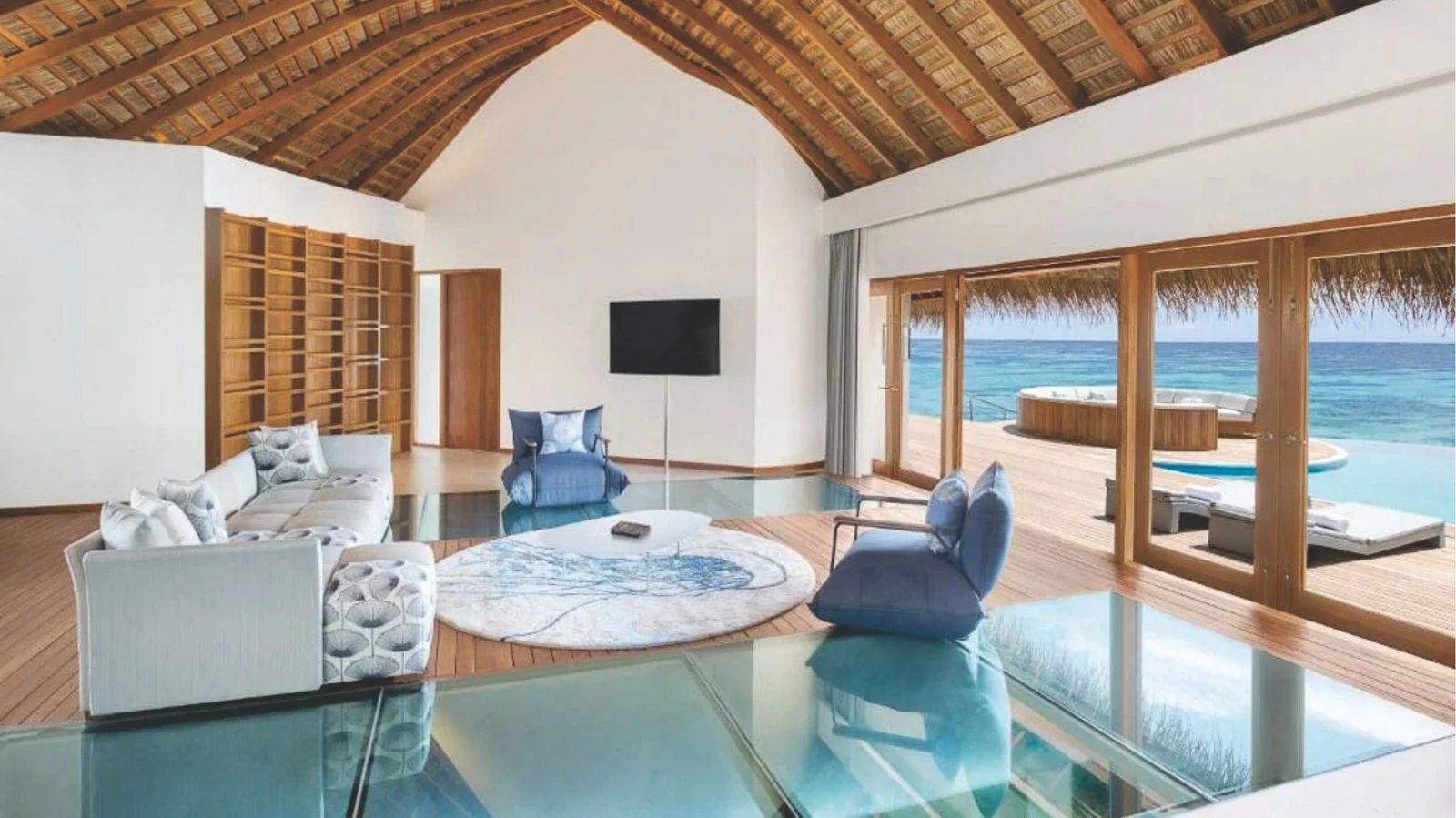
That is the absolute promise of best water bungalows 2026 models featuring private glass floor panels. It is like having a living, shifting aquarium built directly into your real estate.
Table of Contents
ToggleBut here is where the fairy tale ends and the logistics slap you in the face. You log onto luxury travel blogs. You see thousands of identical, heavily filtered photos. You start opening tabs. Suddenly, you realize some “glass floors” are just tiny peek-a-boo windows the size of a pizza box hidden under a coffee table. Others are giant structural viewing panes that span the entire living room floor.
I am Ismail Naazim. I am a Maldivian native who designs SEO structures and analyzes luxury resort architectures for a living. I know exactly how these structures are built, where the builders cut corners, and which properties are pulling a fast one on you with clever camera angles.
If you are currently stuck in the paralyzing “consideration phase”—trying to weigh a $3,500-a-night lagoon villa in the Maldives against an estate in Bora Bora or an all-inclusive setup in Jamaica—this breakdown is your definitive blueprint. No fluff. Just real insights.
1. Global Geography: The Marine Topography Factor
Let’s understand one thing immediately: a glass floor panel is completely useless if the water underneath it looks like murky soup or empty grey sand. The brilliance of this specific feature depends entirely on the marine topography and tidal patterns of the region you choose.
The Maldives: The Gold Standard of Clarity and Coral Architecture
As a Maldivian, I say this without bias: our geography was practically tailor-made for glass floor viewings. The Maldives is made up of 26 natural coral atolls. Our luxury overwater villas are built inside shallow, enclosed lagoons protected from harsh ocean swells by outer reef walls.
The water here is incredibly clear because the white sand is coral-based, not quartz-based. It reflects the sunlight perfectly. More importantly, many Maldivian resorts build their overwater structures directly on top of active house reefs or shallow sandflats where eagle rays, stingrays, and juvenile sharks hunt daily. When you look through a glass panel here, you are genuinely looking at a bustling wild ecosystem.
Bora Bora: Majestic Backdrops, Deep Lagoon Shadows
Bora Bora is stunningly beautiful. The jagged peak of Mount Otemanu rising out of the water takes your breath away every time. However, the overwater bungalows here are often situated over deeper, vast lagoon floors.
Because the water drops off more aggressively than in the Maldives, the view through your glass floor can sometimes look like an endless expanse of deep, dark blue rather than an active reef. The resorts that do this well—like the St. Regis or Conrad Bora Bora Nui—have to deliberately cultivate artificial coral gardens beneath their structures or place them over specific shallow sand motus to give you something to actually look at.
The Caribbean: Micro-Climates and Atlantic Swells
The Caribbean has stepped up its overwater game massively over the last few years. Properties in Jamaica, St. Lucia, and private islands in Belize now offer exceptional overwater setups.
But you have to be very careful with seasonal seaweed shifts (like Sargassum blooms) and coastal tidal variations. If a resort is located in an area with heavy surf, the sand underneath your villa gets kicked up constantly. That means your million-dollar view through the floor turns into a cloudy, turbulent washing machine. In this region, you want landlocked lagoons or highly protected bays.
2. Transit Logistics: The Exhausting Truth
Let’s talk about the journey. The glossy travel brochures always cut from the international flight arrival straight to a couple sipping champagne on their deck. They edit out the grueling six to twelve hours of transition time in between.
Seaplane vs Speedboat Logistics in the Maldives
If you choose the Maldives, this is the single biggest operational decision you will make. It changes your budget, your scheduling, and your stress levels.
Speedboat Transfers: If you stay in the North or South Malé Atolls (like Waldorf Astoria Ithaafushi or Taj Exotica), your journey is seamless. You land at Velana International Airport (MLE), walk out to the marina, and step onto a luxury speed cruiser. Within 20 to 45 minutes, you are inside your villa. No waiting around. No strict luggage weights. If your international flight arrives at 9:00 PM, you can still transfer to your resort immediately.
Seaplane Transfers: If your chosen glass-floor villa is located in the more remote, untouched northern or southern atolls (like Noonu, Baa, or Raa Atolls), you must take a Twin Otter seaplane. The views are otherworldly—you see the ring-shaped atolls scattered across the deep ocean like emerald necklaces. But seaplanes operate strictly on Visual Flight Rules (VFR). They cannot fly after dark. If your international flight touches down in Malé after 3:30 PM, your vacation halts. You will be forced to spend a frustrating night at a transit hotel on the crowded airport island of Hulhumalé.
Native Perspective: Do not underestimate the sensory assault of a seaplane if you value peace. They are loud, completely un-airconditioned, and smell strongly of aviation fuel. If you are traveling with infants or elderly family members, a luxury speedboat or a domestic flight followed by a short boat hop is a much gentler experience.
Bora Bora and the Caribbean Transit Dynamics
Bora Bora requires you to take a domestic flight from Tahiti (PPT) to the tiny island airport of Motu Mute (BOB). From there, a private resort boat whisks you across the lagoon. It is beautiful, but if your international connection is delayed, you face overnighting in Papeete.
The Caribbean wins the logistics battle hands down for North American travelers. Direct flights into Montego Bay or St. Lucia mean you can often be sitting on your overwater deck looking through your glass floor by early afternoon, completely avoiding the multi-day jetlag associated with the South Pacific or Indian Ocean.
3. Villa Anatomy: Designing the Perfect Viewing Experience
Not all glass floor installations are designed well. In fact, many of them are outright frustrating once you actually live in the space for a week. When you are paying top-tier luxury prices, engineering details matter.
Overwater Bungalow Privacy Audits
Privacy is the ultimate luxury, but it is frequently sacrificed for density. Resorts want to squeeze as many villas as possible onto a single wooden jetty.
When conducting your own overwater bungalow privacy audits, you need to study the satellite imagery of the resort layout before booking. Look at the spacing between the boardwalk arms. If your glass floor is located in the entrance hallway, and your villa sits directly opposite another villa’s entryway, you will have to keep your blackout curtains closed all day. That completely ruins the open, airy feeling of overwater living.
The best designs use a staggered or “herringbone” jetty layout where the villas are angled away from each other, ensuring that your outdoor deck and your internal glass viewing panels are completely shielded from the sightlines of neighboring guests or passing golf carts.
The Insider’s Checklist for Villa Features
Before you wire a deposit or authorize a credit card charge, make sure your villa configuration ticks these specific technical boxes:
Night Illumination Switches: Marine life is nocturnal. The big sharks and predatory rays come out to hunt under your villa after the sun goes down. A world-class water bungalow must have independent, switchable underwater LED floodlights installed directly beneath the glass floor. Without these lights, your glass floor turns into a pitch-black, reflective mirror the moment night falls.
Sunrise vs. Sunset Orientation: This choice changes the internal temperature of your villa and the quality of your floor viewing. Sunrise-facing villas get blasted with intense, direct light early in the morning. This creates a severe glare on internal glass panels, making it hard to see the fish without cupping your hands around your eyes. Sunset villas offer softer afternoon light and stay cooler during the peak hours of the day, though your air conditioning unit will work double-time between 4:00 PM and 7:00 PM.
Panel Location and Material: Insist on glass floors located in high-traffic, interactive zones—like around the master bed, flanking the bathroom vanity, or running down the center of the living room. Avoid designs where the glass is placed under a fixed, heavy coffee table. Moving a 100-pound teak table every time you want to look at a fish gets old very quickly.
4. Budget, Value, and the Meal Plan Minefield
The base rate you see on booking platforms is a deceptive mirage. In the luxury overwater space, the hidden costs can easily equal forty percent of your total room bill by the time you check out.
All-Inclusive vs Half-Board Maldives
Because you are confined to a private island infrastructure, you cannot simply walk down the street to a local bistro when you get hungry. You are completely captive to the resort’s culinary ecosystem.
Half-Board Packages: This typically covers breakfast and dinner at the main dining room. If you are someone who likes to sleep late, eat a massive brunch at 10:30 AM, and skip lunch completely while lounging over your glass floor, this is an exceptional value proposition. However, you need to verify if beverages—including plain water—are included during dinner.
All-Inclusive Packages: This sounds stress-free, but you must read the fine print with extreme scrutiny. Many ultra-luxury resorts offer “tiered” all-inclusive structures. A standard all-inclusive package might cover your meals at the buffet, but exclude the fine-dining overwater Japanese restaurant or the underwater wine cellar. It might include house wine but slap a $45-a-glass surcharge on a premium Champagne.
Native Perspective: In the Maldives, import taxes and religious regulations mean alcohol is a highly controlled commodity. A single cocktail at a luxury resort routinely costs $28 to $35 USD before service fees. If you enjoy premium spirits or wine throughout the day, choosing a comprehensive, top-tier all-inclusive plan will save you thousands of dollars on your final invoice.
The Reality of Hidden Costs
Let’s look at the financial line items that travel agents love to gloss over until you receive the final invoice.
The 26% Tax Trap: In the Maldives, every single transaction—from a bucket of ice to a private sandbank dinner—is subject to a mandatory 10% Service Charge plus a 16% Tourism Goods and Services Tax (TGST). These taxes are calculated compoundingly. If a jet-ski rental says $300, it is actually $378. Keep this mental math sharp.
The Green Tax: A flat environmental levy of $6 USD per person, per night. It is small, but it applies to every single guest, including infants.
The Water Premium: If your resort does not operate its own reverse-osmosis desalination and glass-bottling plant, you will be charged for imported mineral water. It is not uncommon to see a charge of $14 to $18 USD for a single bottle of San Pellegrino or Evian at lunch.
5. Sustainability: Preserving the Aquatic Floor View
The irony of a glass floor panel is that the very act of building the villa can destroy the reef you are looking at. If a resort does not prioritize marine conservation, you will eventually find yourself staring down at dead, bleached calcium skeletons and empty grey sand.
Eco-Friendly Pile Construction
Traditional overwater construction involved driving massive, solid concrete pillars directly down into live coral colonies. This crushed the local reef structure and permanently altered the water currents, leading to severe island beach erosion.
The best luxury overwater villas constructed recently utilize advanced titanium or high-grade steel screw-piles. These piles are literally twisted into small, sandy gaps between coral heads with surgical precision, minimizing the physical footprint on the seafloor and allowing natural current channels to remain completely uninterrupted.
Active Reef Management
Properties like Gili Lankanfushi and Joali Maldives employ dedicated teams of resident marine biologists. Before a single piece of wood is laid for an overwater jetty, these scientists map the lagoon bed. If a valuable coral colony is located where a villa’s shadow will block its sunlight, they carefully fragment and relocate the coral to a dedicated underwater nursery.
When you support a resort that runs a coral propagation program, you are ensuring that the vibrant blue ecosystem beneath your feet stays alive for generations to come.
The Ultimate Verdict: Which Property Deserves Your Deposit?
If your absolute priority is sheer size and structural drama—where the glass floor is an expansive, architectural centerstage that runs throughout your entire living space—the Maldives remains the undisputed world champion. Properties like the Soneva Jani or The Ritz-Carlton Maldives, Fari Islands offer unmatched glass integration and unparalleled marine visibility.
If you are looking for classic, Old-World romantic charm where the glass panel acts as a subtle, enchanting window framed by traditional thatched-roof craftsmanship and dramatic mountain backdrops, Bora Bora is your clear winner. The St. Regis Bora Bora Resort offers some of the largest standard overwater floor templates in the South Pacific.
For those who prioritize seamless travel logistics, minimal jetlag, and the ease of a premium all-inclusive structure without sacrificing the thrill of looking down into clear tropical waters from your bedroom, look directly at the Caribbean market—specifically Sandals Royal Caribbean in Jamaica or the ultra-private enclaves in Belize.
Leave Your Review Here
There are no reviews yet. Be the first one to write one.


